On a Monday in February 2023, Google announced Bard, its answer to ChatGPT, the chatbot that had become a viral success. The next day, Microsoft launched a new AI-powered Bing, built on technology from ChatGPT's maker, OpenAI.
A promotional video showed Bard giving a wrong answer about the James Webb Space Telescope. On Wednesday, after Reuters reported the error, Alphabet's shares fell 7.7%, wiping $100 billion off its market value. Some Google employees called the announcement “rushed” and “botched” on an internal forum.
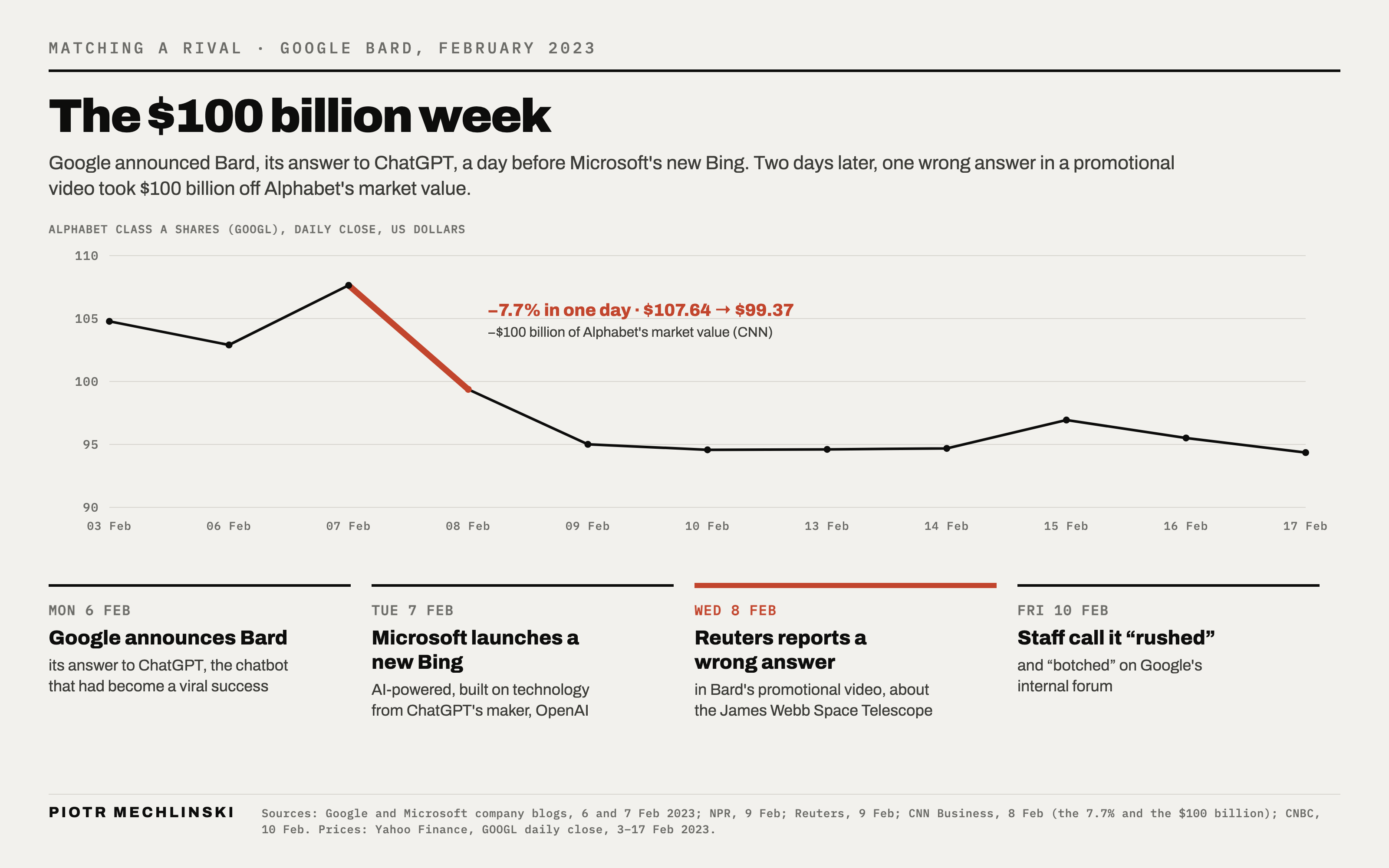
That is what matching a rival's AI launch can cost in public.
Most companies pay in a quieter currency.
An executive team looks productive. Twelve meetings. Three new AI pilots. A weekend of urgent messages.
Yet nobody can state which decision changed.
Activity has become a painkiller for anxiety. The team feels movement, so it mistakes movement for progress.
Panic can look exactly like productivity.
What the room rewards
A competitor launches an AI assistant. A board member forwards a dramatic headline. A vendor announces another breakthrough. The pressure rises, and the organization starts moving.
Executives request new presentations. Teams open pilots. Calendars fill with steering meetings. Leaders ask for daily updates on work that still lacks a customer problem, an owner or a measure of value.
Each action offers a small emotional reward. “We are doing something.” The strategic position may not improve at all.
Pressure changes what the room rewards. Visible action becomes easier to defend than deliberate judgment. A 2023 series of eight studies found that people treat displays of effort as a sign of moral character. In the authors' words:
The exertion of effort is deemed morally admirable … and is monetarily rewarded …, even in situations where effort does not directly generate additional product, quality, or economic value.
I learned the difference underwater.
Years ago, I spent three months on an island in the Indian Ocean, freediving. Beneath the surface, effort has a visible cost. Every unnecessary movement consumes limited capacity. The water does not reward how busy you look. It rewards preparation, strategy and efficiency.
The lesson was to read the situation accurately before spending energy. Danger still demands action.
The analogy has a hard limit. In the water, the urge to breathe is a warning to respect, never to override. Divers Alert Network (DAN) is direct: get formal training, never freedive alone and never hyperventilate before a dive, because hyperventilation weakens that warning. What carries over to the boardroom is the protocol. DAN's risk-assessment guidance centres on training, briefings, capable buddies, known limits and an emergency plan.
Lowering the pressure does not automatically make a leader smarter. A 2024 integrative review found that the effect of stress on decisions depends on the stressor, its timing, the type of decision and the individual. What a protocol does is practical. It makes the real decision explicit before the organization pays for the reaction. During a real production incident, contain harm immediately. When a regulatory deadline is genuine, meet it.
Put urgent AI work through the Calm Gate
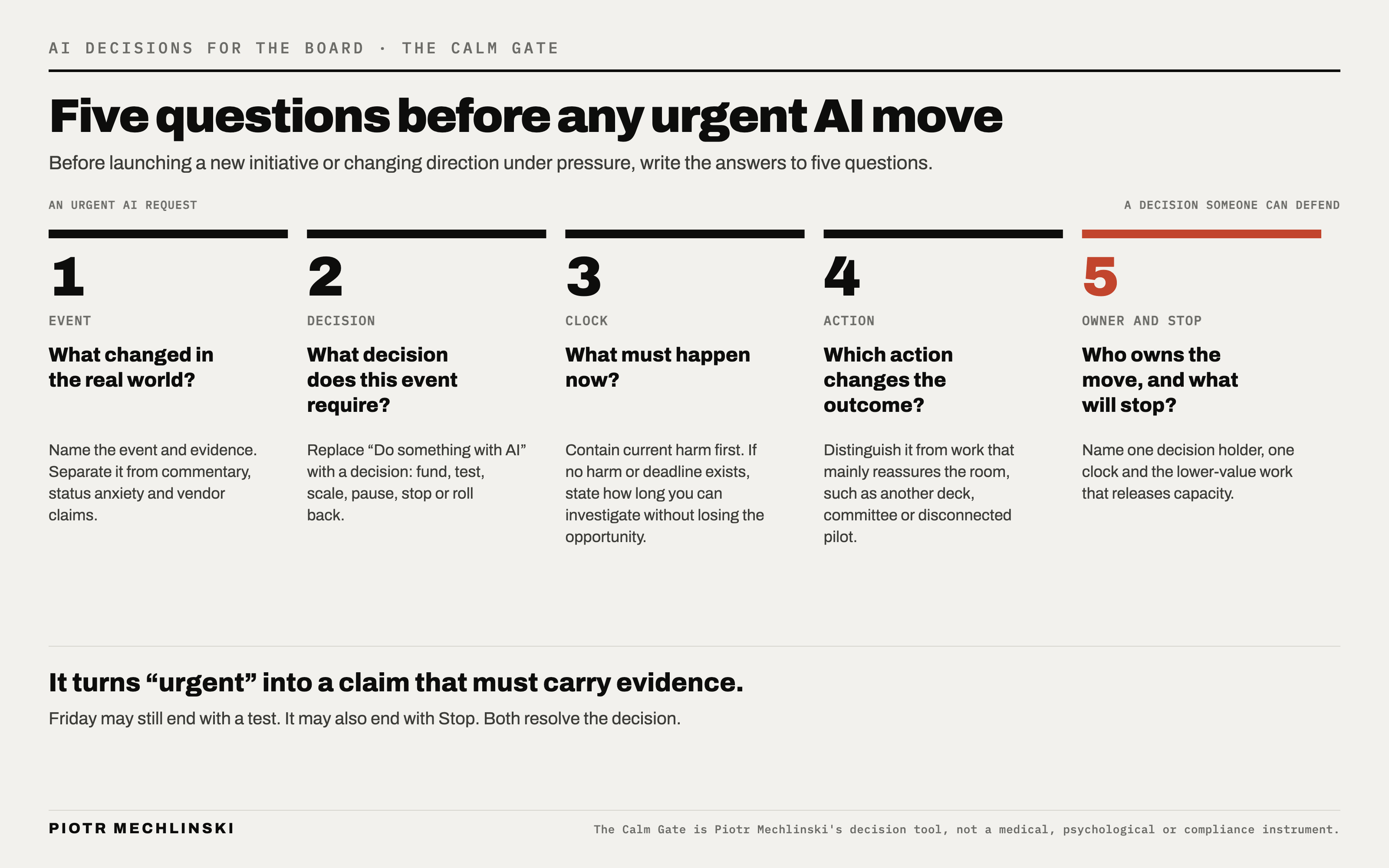
Here is the boardroom version of that protocol. Before launching a new initiative or changing direction under pressure, write the answers to five questions:
- What changed in the real world? Name the event and evidence. Separate it from commentary, status anxiety and vendor claims.
- What decision does this event require? Replace “Do something with AI” with a decision: fund, test, scale, pause, stop or roll back.
- What must happen now? Contain current harm first. If no harm or deadline exists, state how long you can investigate without losing the opportunity.
- Which action changes the outcome? Distinguish it from work that mainly reassures the room, such as another deck, committee or disconnected pilot.
- Who owns the move, and what will stop? Name one decision holder, one clock and the lower-value work that releases capacity.
Call this the Calm Gate. It turns “urgent” into a claim that must carry evidence.
Your version of Google's Monday will not make the news. A competitor launches an AI service in your market on Monday morning. By 10:00, the CEO wants a matching product by Friday. The calendar fills before anyone has spoken to a customer.
The Calm Gate changes the work. The event is a competitor announcement. It creates no immediate customer harm and no external deadline. The decision is whether the new service changes customer expectations enough to justify a focused test. A product owner gets two days to examine customer demand, the competitor experience, the required data and the smallest reversible experiment. The team also names the existing initiative that would lose capacity if the test starts.
That initiative is your price of matching. The Calm Gate names it before anyone pays it. In a panic, it quietly stops while the room looks busy.
Friday may still end with a test.
It may also end with Stop.
Both are productive because both resolve the decision. Five reactive pilots resolve nothing.
Calm makes courage usable
Calm alone can become avoidance. A beautifully facilitated pause that ends without a decision is still theatre. The decision holder has to make Friday's call and defend it, whether it is a smaller test than the CEO asked for or a Stop the room will not like.
Courage supplies the commitment. Calm protects the quality of that commitment. Together they create clarity about what deserves action and what should stop.
Take the most urgent AI request on your agenda this week. Run it through the five questions before the next meeting.
If the request cannot name the event, decision, evidence, owner and work to stop, it is still anxiety wearing a project plan.
Your move.