The plan was six months.
It has been seven years.
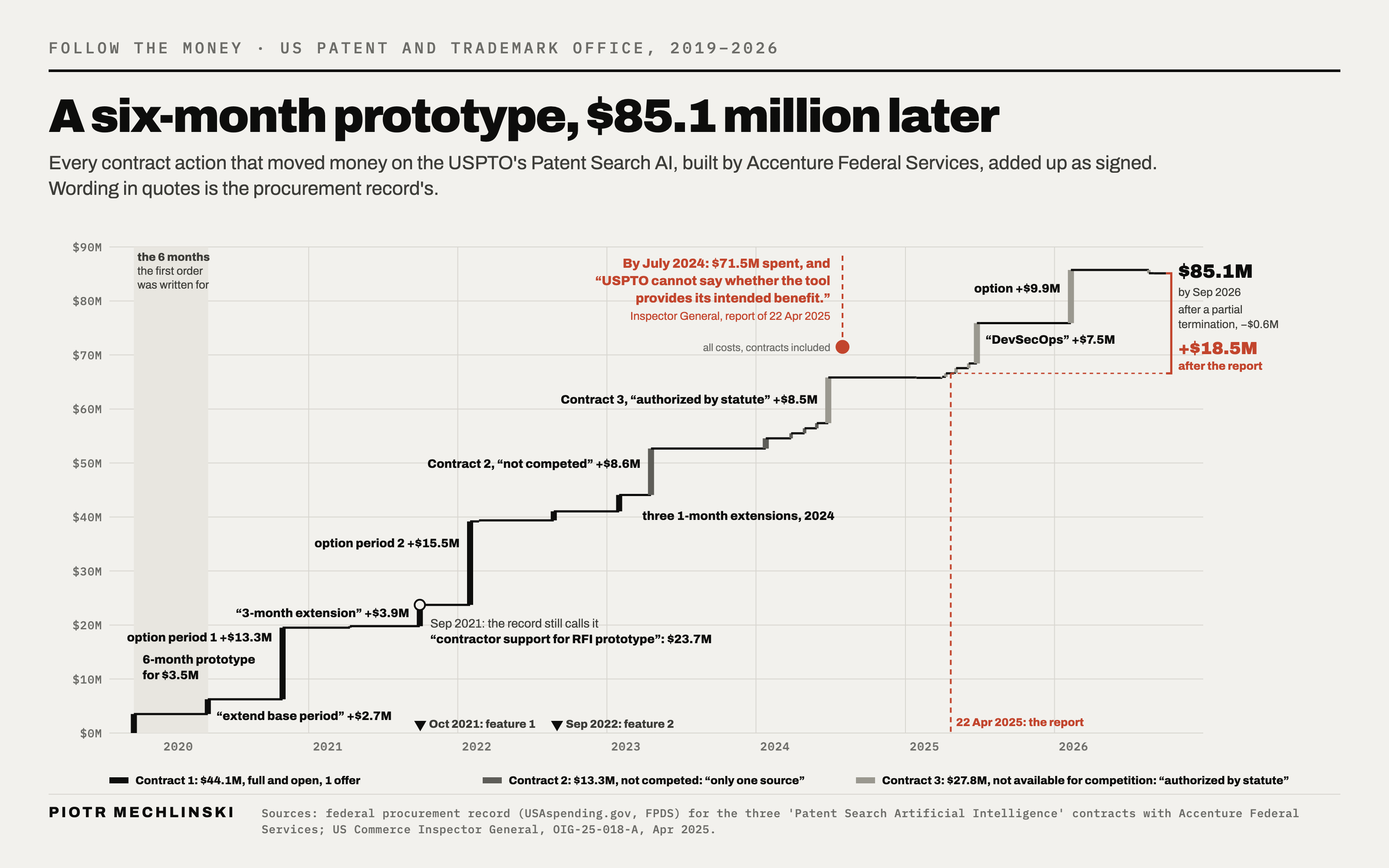
In October 2019 the US Patent and Trademark Office ordered an AI prototype to improve patent search. Six months, $3.5 million. The contracts that grew out of it now add up to $85.1 million, and the current one can run to 2029. Along the way, the government's own auditor found that the office could not say whether the tool helped.
I followed that money through the federal procurement record, all 26 contract actions that moved it.
Six months, then 42 months
The first extension came before the six months were up. In April 2020 the record says "extend base period", for $2.7 million more. Option period 1 followed in October 2020, at $13.3 million.
In September 2021 came a "3-month extension" for $3.9 million. The record still calls the work "contractor support for RFI prototype". By then the prototype had taken $23.7 million.
The tool did ship. Its first feature, More Like This Document, went live for examiners in October 2021. The second, Similarity Search, followed in September 2022. In between, option period 2 added $15.5 million.
The first order had gone out under full and open competition, and one offer came in. The next two contracts were not competed at all. The second, in April 2023, is recorded as "not competed" because of "only one source": $13.3 million. The third, in June 2024, was "not available for competition" and "authorized by statute": $27.8 million so far.
This needs no villain. After years on the job, the incumbent knows the system better than anyone, and a switch looks like risk. Each renewal is the safe choice on the day it is made. The record names the contractor as Accenture Federal Services. The audit I quote next names no contractor at all.
What the audit found
In April 2025 the Commerce Department's inspector general published a review of the patent office's AI tools. It found that about $71.5 million, including contract costs, had been spent on the patent search tool by July 2024, "but USPTO cannot say whether the tool provides its intended benefit."
The reason fits in one line of the report:
Success was measured by whether the tool was released.
The office counted how many examiners used the tool. It did not track whether their searches got better. The report also says the tool was "mandated by the then-USPTO Director", with "short timelines".
The examiners had a view too. In the auditors' survey, answered by 1,822 of the 8,805 examiners, 40% of users were satisfied with More Like This Document and 36% with Similarity Search.
The office replied that the tool was built with metrics on how examiners used it, and it agreed with every recommendation. The finding is about measurement. The tool may well help examiners. The office had set up no way to show it.
The money did not stop.
The report came out on 22 April 2025. Then came $7.5 million for "DevSecOps" in June 2025 and an option worth $9.9 million in February 2026. A partial termination in August 2026 removed $0.6 million. In all, $18.5 million was committed after the audit. From the outside, nobody can tell whether that money was tied to the measures the auditors asked for.
Where the money was decided
This is the number I would put in front of a board. Of all the money added across the three contracts, 24% was committed when a contract was signed. The other 76% came later, in 19 changes: options exercised, extensions and supplemental agreements.
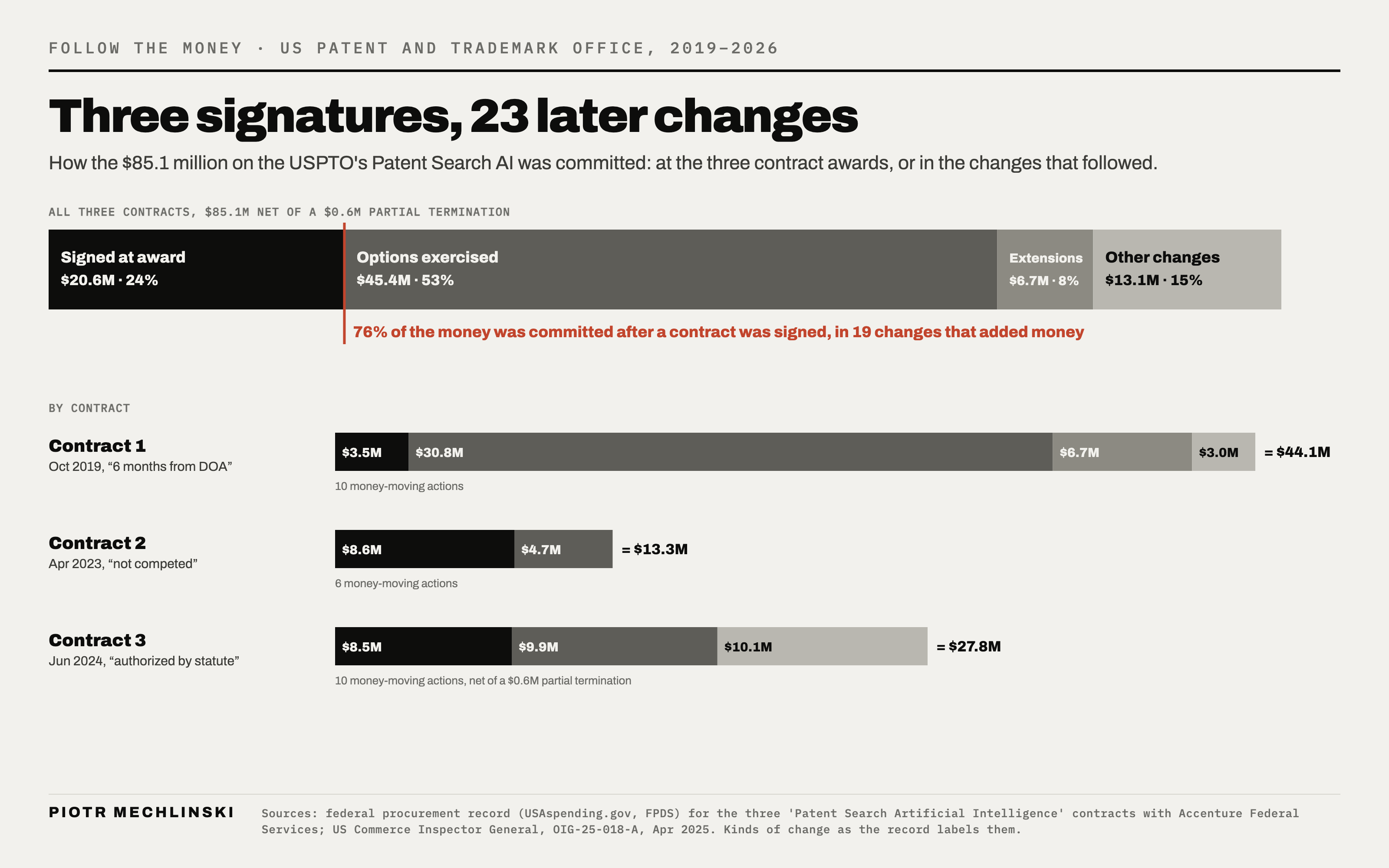
Options are priced when a contract is signed. Exercising one is still a decision, made long after the business case. Each of those 19 changes was a point where someone could ask what the last tranche had bought. The audit says the office had no measure that could answer.
The introductory price
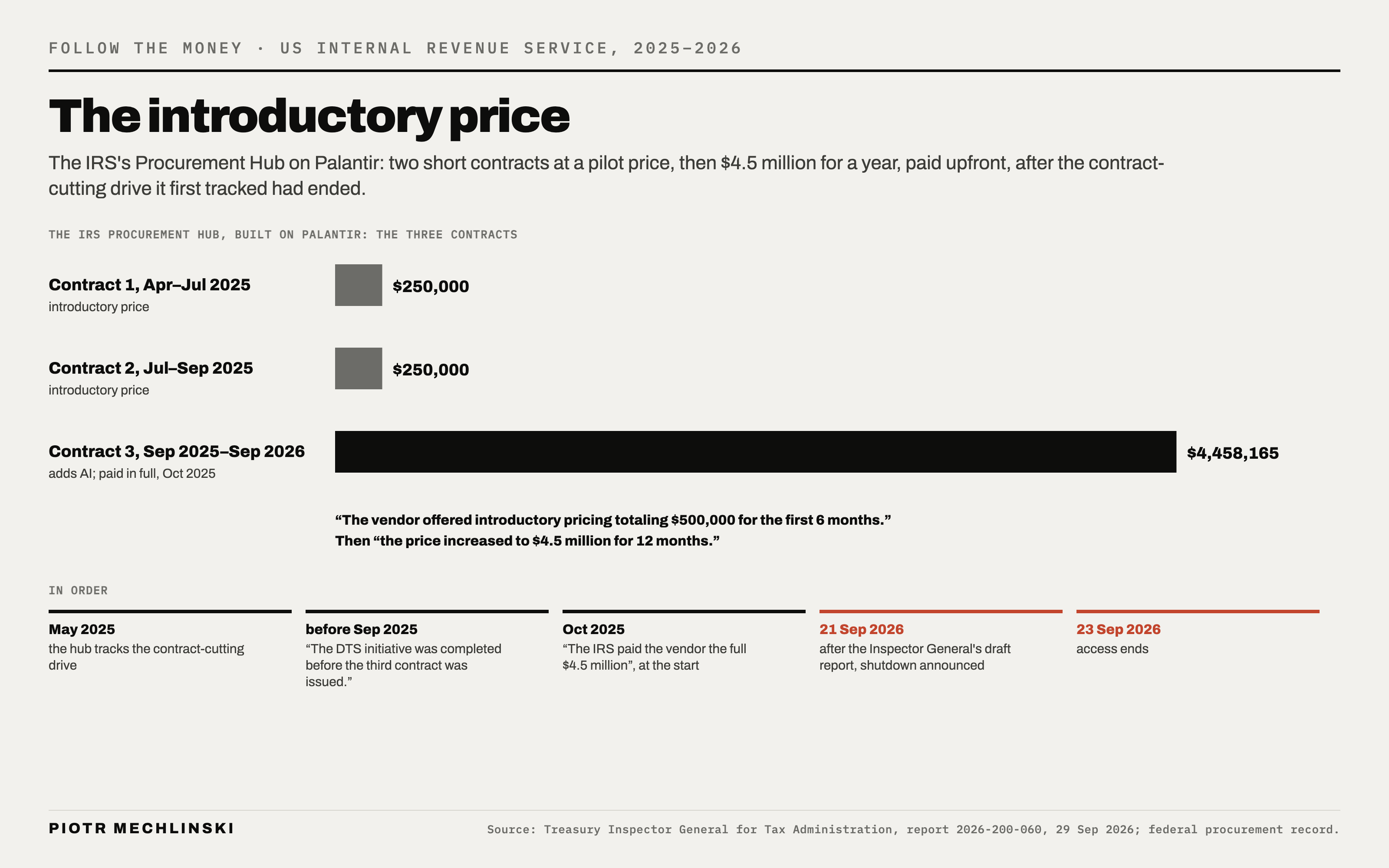
The second case is smaller and faster. In April 2025 the IRS bought a Procurement Hub, built on Palantir, to track its part in the government's "Defend the Spend" (DTS) contract review. The first two contracts were $250,000 each. In the words of the Treasury's tax inspector general, "The vendor offered introductory pricing totaling $500,000 for the first 6 months."
Then "the price increased to $4.5 million for 12 months." The IRS paid the full amount upfront, in October 2025. It said software licences are paid that way. The inspector general accepted that for the licence. For the engineering work, it found no clear milestones or deliverables. It also found the IRS had not done enough market research, despite the price jump.
The drive the hub was first used for had already ended: "The DTS initiative was completed before the third contract was issued." The IRS kept exploring other uses, such as AI for acquisition planning. On 21 September 2026, after the inspector general sent its draft report, the IRS announced it would shut the hub down. Access ended two days later.
Two prices
Every AI pilot has two prices. The first is on the order, and it comes with a business case. The second arrives in options, extensions and follow-on contracts.
At the patent office the first price was $3.5 million and the second, so far, $81.6 million. At the IRS the first was $0.5 million for six months. The second was $4.5 million for a year, paid at the start of that year.
So write three things down before anyone exercises the first option:
- The benefit the pilot must show, as a number someone outside the project can check.
- The date by which it must show it.
- The total if every option runs. At the patent office, the current contract alone can run to September 2029.
Then hold one rule. A pilot that outlives its first term comes back to the board as a new decision, with those three lines on the first page.
To start this week, ask for the full change history of your three largest AI contracts. Add up what was committed after signature. Then ask who approved that money, and against what measure.
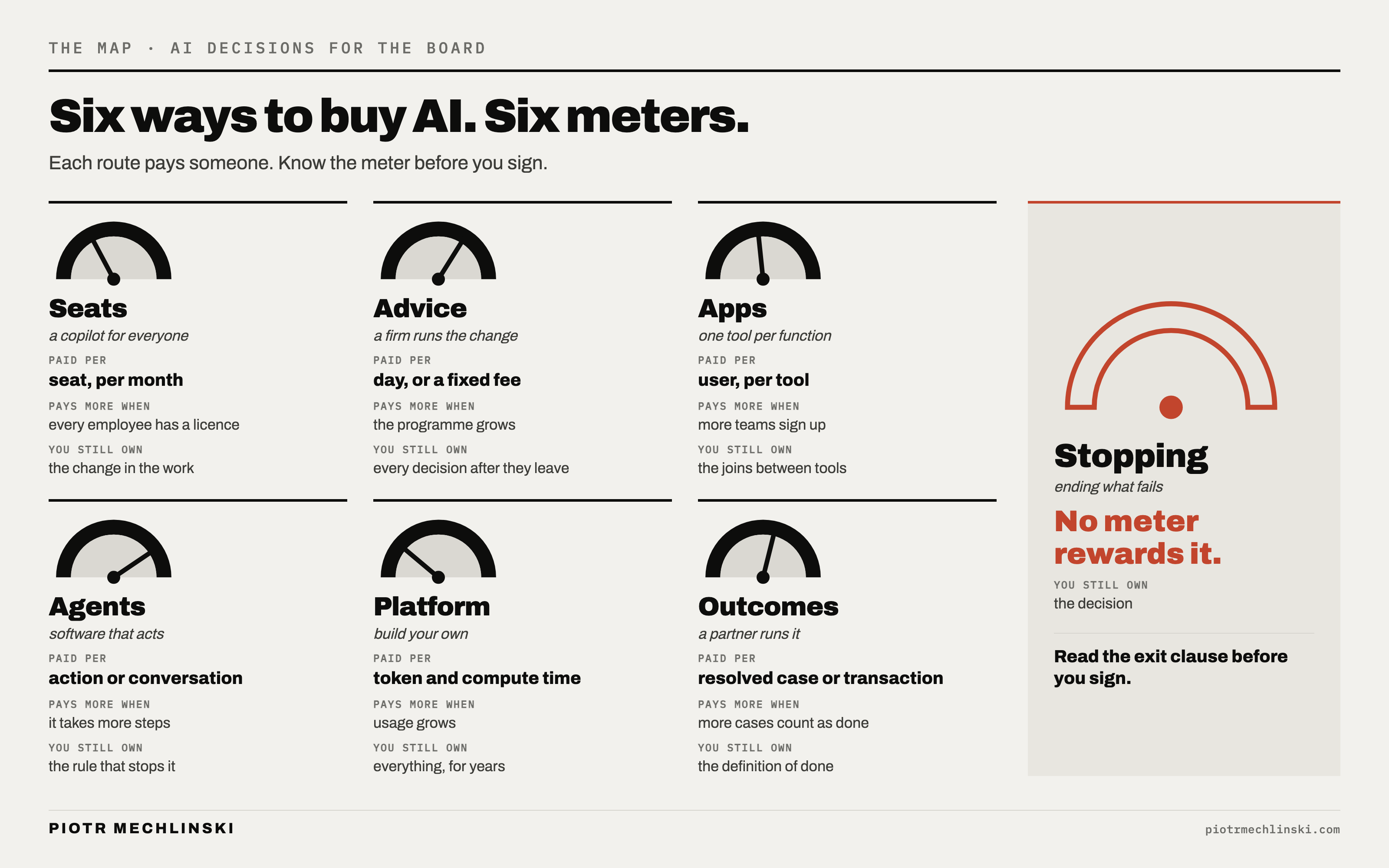
The map: Six ways to buy AI, six meters. The seventh is the one no meter rewards: stopping.
Your move.