Your AI label can be correct while your content process remains irresponsible.
The disclosure appears. The workflow behind it is still empty.
A model drafts the text. An agency edits it. Legal checks one paragraph. Marketing approves the campaign. A platform publishes it. Every handoff looks reasonable until a factual error, manipulated image or damaging claim reaches the public.
When harm reaches the public, the company needs a named editor who can explain and defend the decision.
The law now makes the distinction visible
Article 50 of the EU AI Act has applied since 2 August 2026. Its transparency duties differ by role, system and content.
Providers of systems that generate synthetic audio, images, video or text face machine-readable marking duties, subject to technical limits and defined exceptions. Deployers face separate disclosure duties for deepfakes and for certain AI-generated or manipulated text published to inform the public on matters of public interest.
For that public-interest text obligation, the AI Act provides an exception when the content has undergone human review or editorial control and a natural or legal person holds editorial responsibility for publication. Deepfakes and provider marking follow different rules.
The Commission's final Article 50 guidance and current FAQ clarify the standard. Human review examines substance using relevant knowledge and professional judgment. Editorial control means real authority to approve, alter or reject the substance, including fact-checking and source assessment. A spelling or grammar check is not enough.
Your legal team must determine which duties, exceptions and transition provisions apply to the exact system and workflow. This essay is operational guidance, not legal advice.
The leadership implication is broader and more durable than one disclosure rule.
A human touch is not the same as human judgment.
Give the editor real authority
The accountable editor is not necessarily a copy editor.
It is the named person who owns the public-content decision. They understand the subject or can obtain qualified review. They can reject the source, change the claim, stop publication and preserve the evidence behind the decision. They know when legal, risk, security or a business owner must enter.
Without those rights, the editor cannot carry the responsibility.
A committee can advise. Several specialists can review. The release still needs one accountable role with enough authority to resolve disagreement and stop the work.
Use one accountability card
Run one record through the content supply chain:
- Content. What did AI generate or materially change, through which system, for which audience and purpose?
- Scope. Is the company acting as provider, deployer or another participant? Is the output public-interest text, a deepfake or another content type that needs specialist classification?
- Review. Who examined the substance, facts and sources? Did that person have relevant knowledge and authority to change or reject the output?
- Disclosure. Which machine-readable mark or visible disclosure may be required, where will it appear and who verifies that it survived publication?
- Evidence. Who keeps the source, model or tool record, material versions, review decision, approval, publication record and escalation path?
The card gives counsel and the accountable editor a visible workflow to assess. Legal classification still requires qualified review. The card also exposes gaps that remain risky even when no specific Article 50 disclosure is required.
Accountability continues after release. The editor needs a correction and withdrawal path, a way to receive new evidence and authority to act when a disclosure disappears during distribution or a source proves unreliable. Keep the published version linked to the review record. A signed approval loses its control value if nobody can revisit it.
Test the highest-consequence path
Do not begin with every employee who asks AI to improve an internal sentence.
Choose the public workflow where an error would matter most. A financial announcement. A health claim. A public-policy statement. A synthetic executive video. A campaign built by several agencies and tools.
Trace one real item from generation to publication. Ask where its facts came from, what changed between versions, who challenged the sources, who classified the disclosure duty and who could stop the release.
Then test the correction path. Give the team a late source challenge or a platform copy that lost its disclosure. Measure whether the accountable editor can locate the affected versions, pause further distribution and issue a correction without waiting for a new committee meeting.
Changing answers at every handoff show that the company has distributed activity without editorial control.
Fix the ownership before debating the label design.
Keep the two questions separate
The legal question is specific: what does this role, system, content and use require under the applicable rules?
The leadership question is permanent: who stands behind the result?
A visible disclosure can help the public understand that AI was involved. It cannot verify the claim, defend the source or accept the consequence. Those decisions remain with the organization and the people it authorizes.
Name the editor. Give them the evidence. Give them the right to say no.
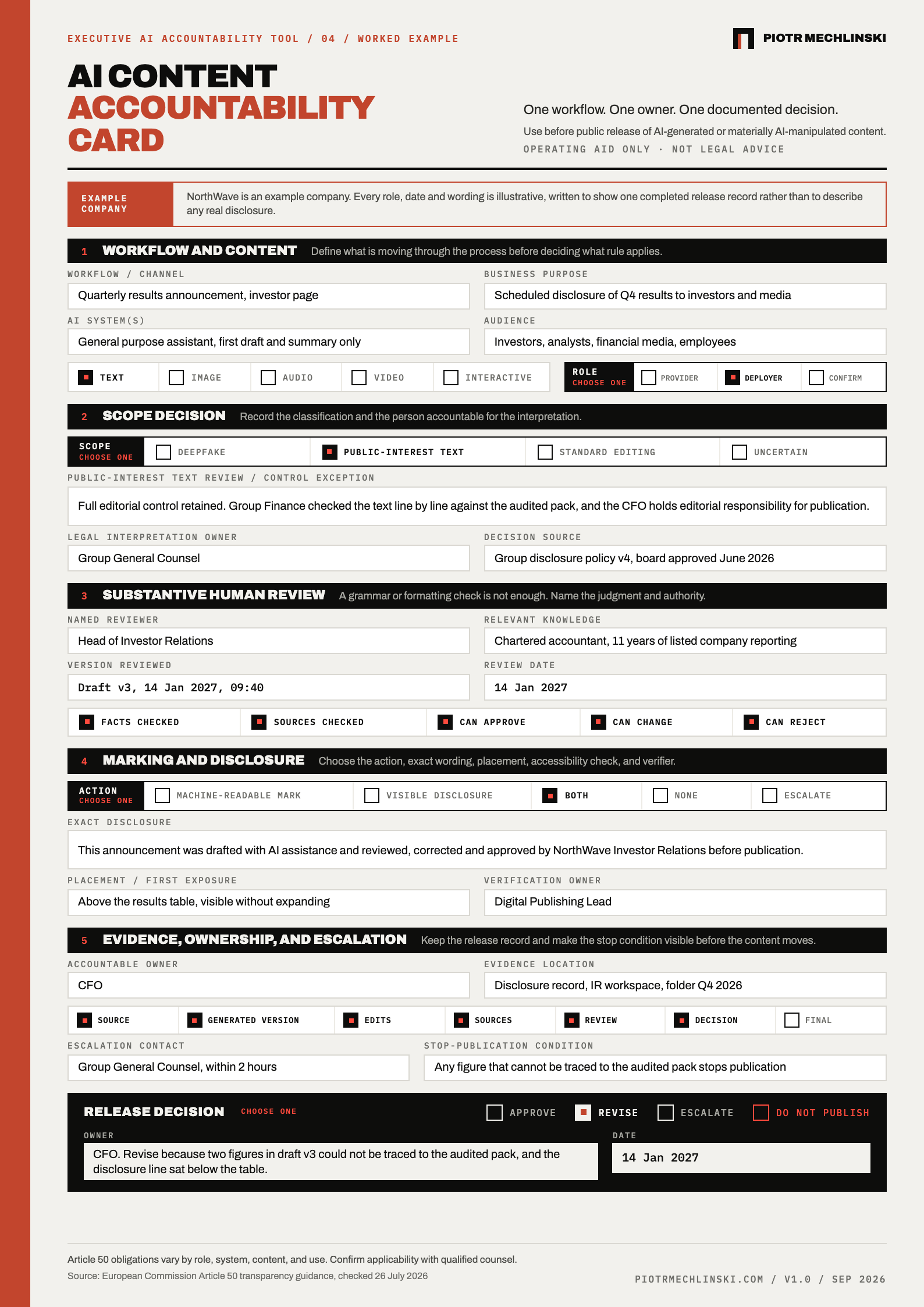
The instrument: AI Content Accountability Card. One page, fillable, free with your email.
Your move.