I have sat on almost every side of the AI table.
Executive. Vendor. Adviser.
The vocabulary changes. The incentives do not.
Projects enter easily. They almost never leave.
Your AI portfolio is a pressure vessel. Every quarter, someone pumps in another pilot, platform, use case, workstream or strategic option. Attention fragments. Accountability thins out. The same scarce people appear on every project plan.
Then everyone wonders why activity rises while impact stays flat.
Rational behaviour by honest people can still produce an irrational portfolio.
Four forces keep the vessel filling
Executives preserve optionality.
When nobody knows which capability will matter next year, ten pilots can look more prudent than two commitments. Every project buys a little political safety. It shows movement, protects a sponsor and postpones the moment when leadership must choose one future over another.
Keeping an option open still consumes money, data, engineering time, management attention and trust. Without an expiry date, it postpones the decision to commit or stop.
Vendors expand their footprint.
Many vendors care about your outcome. Their commercial systems still measure seats, usage, workloads and products inside your architecture. A demo shows what the technology can do. Portfolio governance decides whether this is one of the few capabilities your company should commit to owning.
Internal teams protect relevance.
An initiative creates a sponsor, budget, team and story about why the work matters. Stopping it threatens all four. Sunk cost becomes identity. Activity becomes proof of importance. A weak project develops a strong immune system.
Most governance assigns responsibility for starting. Far less of it rewards someone for releasing people and money from work that no longer deserves them.
Advisers are paid for scope.
More analysis, workstreams, specialists and programme time can each be defensible. Each also raises the fee.
Some advisers argue for concentration. McKinsey's 2026 AI Transformation Manifesto reports that the AI leaders it studied concentrated on one to three business domains, with substantial, stage-gated investments. That is good advice, but the methodology a firm publishes and the model it is paid by are different things.
When fees rise with people, weeks and scope, subtraction has to survive the contract. Pay for decisions, transferred capability and outcomes where you can. Make a smaller answer commercially possible.
The missing job
Most AI portfolios have sponsors, architects, product owners, programme managers, risk leads and steering committees.
Who owns the kill decision?
Plenty of people can stop a project after six red reports. Who is expected to remove work before failure becomes undeniable?
That role is often empty.
The role has been studied. When a doomed project finally stops, the person who stops it is almost never the person who started it. It is the replacement: someone who arrives after a retirement or a restructuring, had no part in starting the work, and can read the evidence for what it is.
Isabelle Royer gave that person a name.
Failing projects are unlikely to be halted without exit champions.
They are not thanked for it. Inside their own companies they get called dream breakers. They put their reputation behind a negative, and they have to be willing to try more than once.
Without that role, every experiment stays funded, and talent spreads too thin to redesign a critical workflow or create clear accountability.
Focused portfolios require leaders to disappoint sponsors whose work no longer earns scarce resources.
Install a relief valve
Boards make subtraction legitimate by setting decision rules and backing the leaders who stop work.
Every material AI initiative should face the same Subtraction Test:
- Result: What economic or operational result changes if this succeeds?
- Fit: Which one of our few strategic domains does it serve?
- Evidence: What evidence, by what date, earns the next round of funding?
- Trade-off: What existing work will stop or move so this receives real people and money?
- Authority: Who has the mandate, incentive and date to kill it?
Vague answers leave the initiative as an option, without the people and money required for a strategic commitment.
The fifth question changes the system. It turns stopping into a designed outcome rather than a career-ending admission.
This is not theory, and it is not AI: it is drug research, where the decision to stop is formal and on the record. AstraZeneca rebuilt that decision around five questions a project had to answer to survive: the right target, the right tissue, the right safety, the right patient, the right commercial case. Projects that could not answer them did not continue. Over the years that followed, the share of candidates surviving to the end of late-stage trials rose from 4% to 19%.
They did not get better at picking winners. They got better at deciding what to stop.
Set the criteria before the demo, before the favourite vendor and before the sponsor falls in love. Give every initiative an evidence date. At that point, leadership must commit, deliberately postpone, reclassify or stop.
The criteria should fit the business. A universal financial threshold or timetable to production creates false precision. A regulated core process and an internal productivity tool need their own thresholds. Both still face the same demand for an explicit result, evidence, trade-off and owner.
Judge the kill owner by the quality of reallocation. A high body count creates a new distortion. Did scarce talent move to the bets that matter? Did decision time fall? Did the selected business result improve?
Ask what should no longer exist
At the next portfolio review, ask what started, what shipped and what changed in the business.
Then ask what should no longer exist.
Name the force keeping it alive. Optionality. Commercial expansion. Internal identity. Advisory scope. Perhaps the evidence genuinely improved. Make the reason visible.
Last, name the person with the mandate, incentive and date to kill it.
If that person is nobody, you already know why the pressure keeps rising.
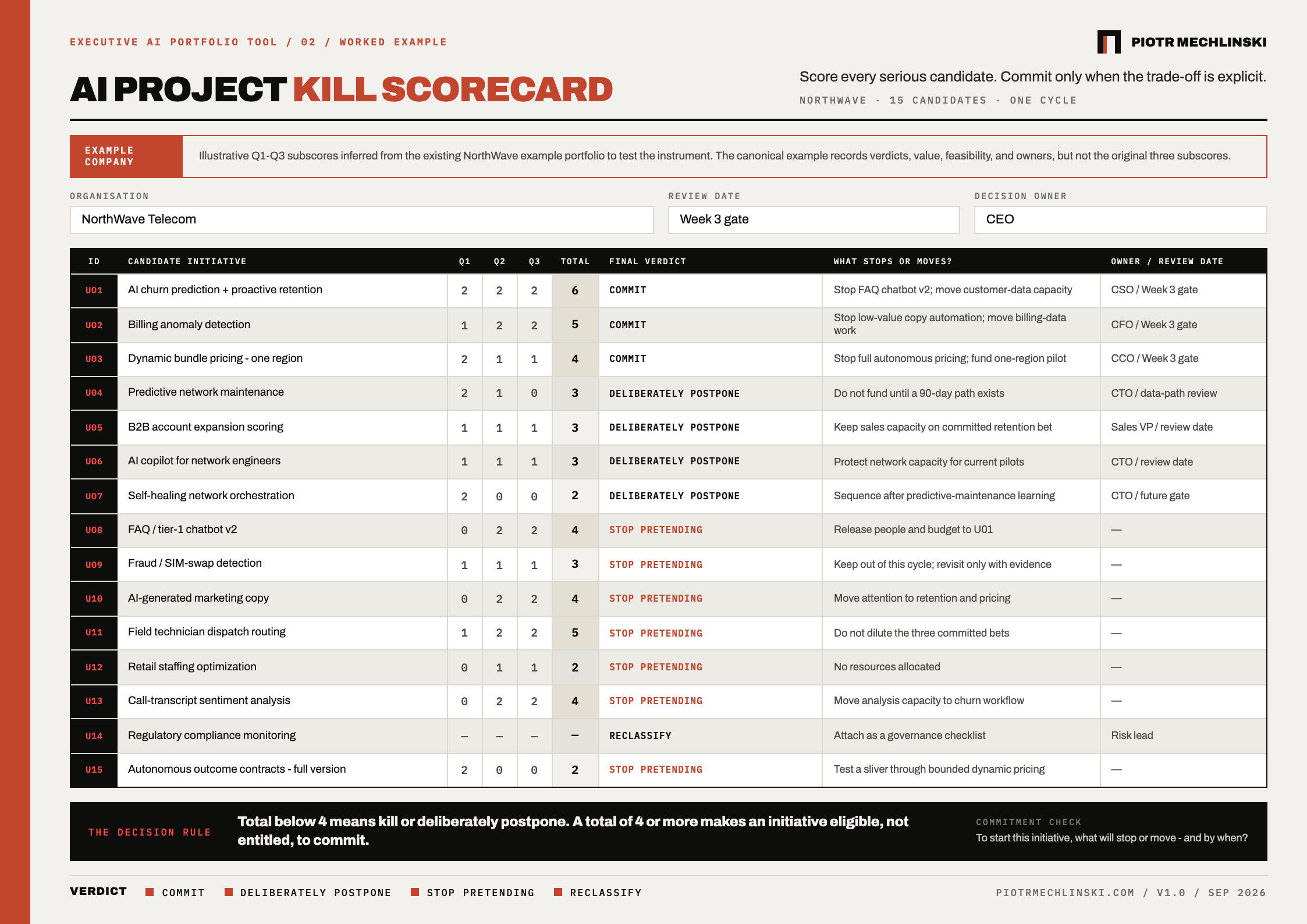
The instrument: AI Project Kill Scorecard. The Subtraction Test sets the terms for each initiative. The scorecard runs the portfolio review across your whole list: three scored questions and a verdict for each candidate, then what stops or moves, with an owner and a review date. Recalibrate its thresholds to your business before first use. One page, fillable, free with your email.
Your move.