Month nine.
The AI works. That is what nobody planned for.
It answers correctly. It saves the hours the vendor promised. Somewhere in finance, a director is staring at what it cost to get there.
The tool was never the expensive part.
Rewind eleven months.
The business case fit on one slide. Licence on the left. Labour saving on the right. A number at the bottom made the decision easy.
Every figure was true. Every one came from somebody whose job ended before the bill arrived.
The vendor closed at signature. The consultant's scope ended at the pilot. The sponsor's objective read "AI deployed," while the system still had to work twelve months later.
Then the project started.
Data needed cleaning. Interfaces needed rebuilding. Security asked for a new control. The process owner found that the old workflow could not carry the promised value. People needed time to learn a different way of working.
Those costs arrived through other budgets. The original case still looked healthy.
The company bought a tool and quietly financed an operating model around it.
The company is illustrative. The mechanics are familiar because one slide carried two blind spots:
The cost side stopped at the tool.
The value side stopped at labour.
The first error underprices change. The second undervalues what the change can build. Put them together and an investment case becomes precise theatre.
Blind spot one: the changed workflow carries the bill
AI adoption numbers make it easy to confuse access with operating change.
The European Central Bank surveyed more than 5,000 euro-area firms. In the final quarter of 2025, over 70% reported using AI. Only 7% reported intensive use.
The barriers named by firms tell the useful part of the story: shortages of AI-related skills at 40%, limited usefulness for their business needs at 28%, and incompatibility with existing systems at 26%. The ECB also notes that integration into core processes can require larger, longer restructuring.
Skills. Process fit. Integration.
These costs rarely sit on the software quote.
A separate IBM survey of 2,000 senior technology executives found that 84% had not fully operationalised AI financial management and 85% lacked full visibility into real-time AI spend. IBM sells technology and consulting, so treat those figures as a supplier-sponsored symptom report, not a universal benchmark.
Before approving an AI investment, price the full workflow across seven layers:
- Model: licence, API, hosting, usage and evaluation environments.
- Data: access, rights, quality, pipelines and stewardship.
- Integration: systems, workflow redesign, testing and exception paths.
- Controls: security, privacy, assurance, human oversight and audit.
- Adoption: role changes, training, protected capacity and communication.
- Lifecycle: monitoring, evaluation, model changes, deprecation and exit.
- Run: support, incidents, infrastructure, vendor management and financial control.
That is the cost side of the True AI Cost Card. It forces the second invoice onto the first slide.
Blind spot two: labour saving is only one kind of value
The opposite mistake is quieter.
Leaders count hours removed because the measure is familiar. They leave new capability outside the case because its value is harder to defend. The result favours small automation over investments that improve data, redesign a process, shorten the next deployment or create a new way to serve a customer.
Strategic value is not permission to invent a heroic number. It needs stronger discipline than a labour-saving estimate.
Take an illustrative project that reads handwritten timesheets from temporary workers. The direct case can measure processing cost, cycle time, error rate and capacity. Useful, but incomplete.
The same project may also produce structured data where five intake channels existed, document exception paths that lived in people's heads, create a reusable integration, and teach managers how to run human review. Each of those changes could make the next initiative faster or enable a service that was previously too expensive.
"Could" carries no value on its own.
Name the decision that the capability changes. Choose an observable measure. Assign an owner. State the evidence date and your confidence. Then model the value as a range or scenario. If you cannot do that, leave the line blank.
Calling an item "AI maturity" does not make it an asset. Showing that the next deployment needs six weeks instead of twelve might.
Calling something "option value" does not make future revenue real. Naming the option, the trigger that opens it, the probability and the investment still required gives the board something it can challenge.
Put both sides into one decision
Use one period for expected value and full cost. Show direct operating outcomes, reusable capability and strategic options on the value side. Put all seven workflow layers on the cost side.
Every material line needs five things: a measure, an owner, evidence, an evidence date and confidence.
A blank means unknown.
Zero requires an owner, evidence and a date.
The finance owner sets the period, challenges attribution and prevents double counting. The process owner owns the changed workflow and the benefits. The technology owner owns the model, data, integration, controls and lifecycle assumptions. Responsible risk, procurement and accounting specialists adapt the treatment where needed.
Then choose a verdict: approve, approve with conditions, rework or stop.
Sometimes the full cost kills the case. Sometimes the strategic value saves it. Both outcomes mean the instrument worked. The decision changed while the budget was still in your hands.
Run the two-sided test before your next AI approval. The first unsupported line shows where optimism has replaced ownership.
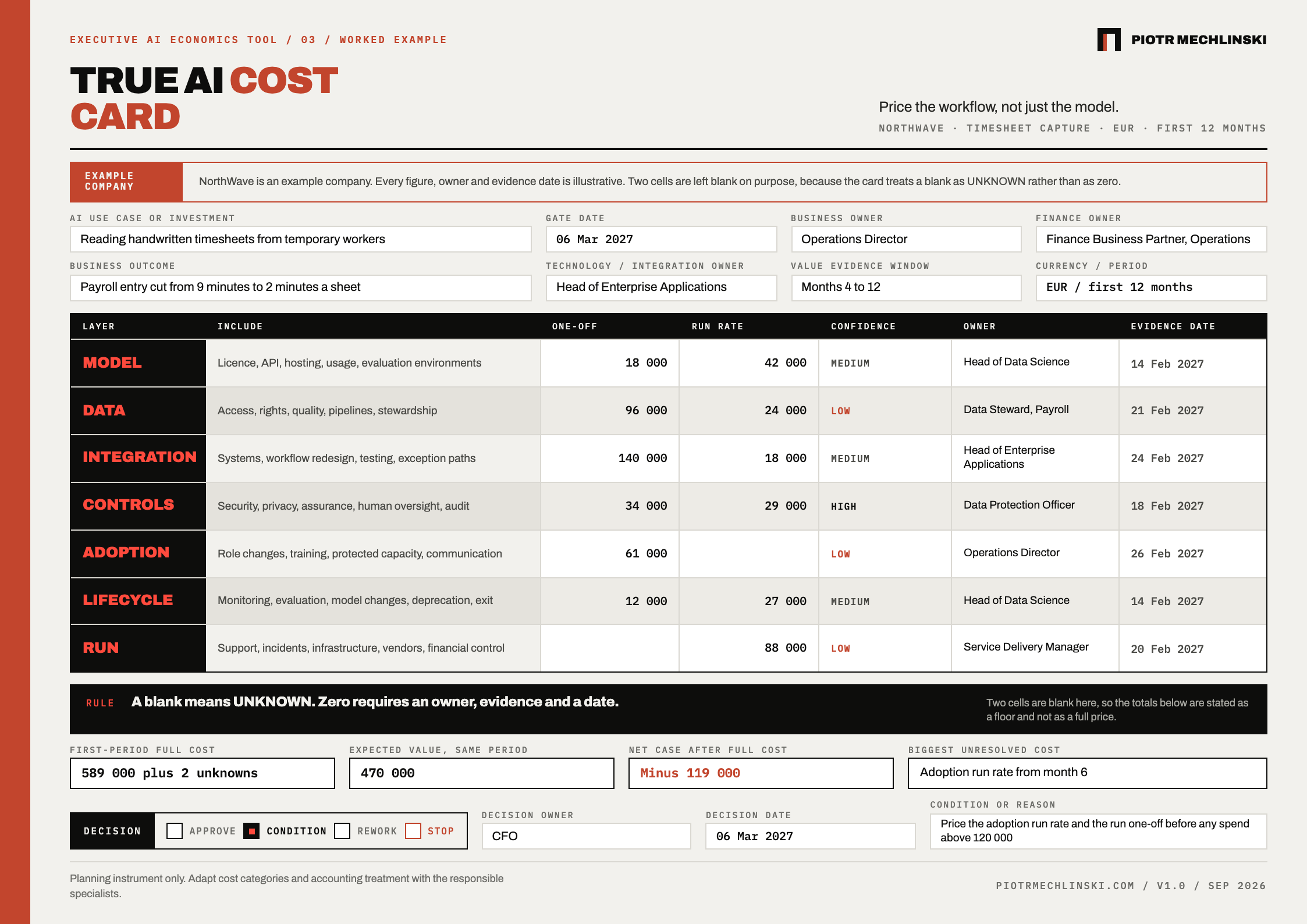
The instrument: True AI Cost Card. One page, fillable, free with your email.
Your move.
Planning instrument only. Adapt the value, cost and accounting treatment with the responsible finance, process, technology, procurement and risk specialists.